25 juni 2026
How is the EU working towards greater energy independence?

Emma Zürcher
Senior beleidsmedewerker
Stel uw vraag
Meer informatie nodig? Stel uw vraag aan één van onze medewerkers

25 juni 2026
Senior beleidsmedewerker
Meer informatie nodig? Stel uw vraag aan één van onze medewerkers
The EU’s ambition for strategic autonomy and competitiveness requires energy security and reliable renewable energy deployment. This is where ‘NORD STORM’ comes into the picture. This collaborative project, funded under Horizon Europe’s Clean Energy Transition Partnership (CETPartnership), aims to make solar panels more capable, more sustainable and cheaper to produce. Researchers, including from Delft Technical University (TU Delft) with support from the Dutch Research Council (NWO), are working on enabling cost-effective large-scale production of more efficient panels. Neth-ER spoke to both Dr. Yifeng Zhao (Assistant Professor at TU Delft) and Dr. Steven Beijer (Programme Officer at NWO) to learn more about how the consortium is tackling some of the EU’s most significant challenges.

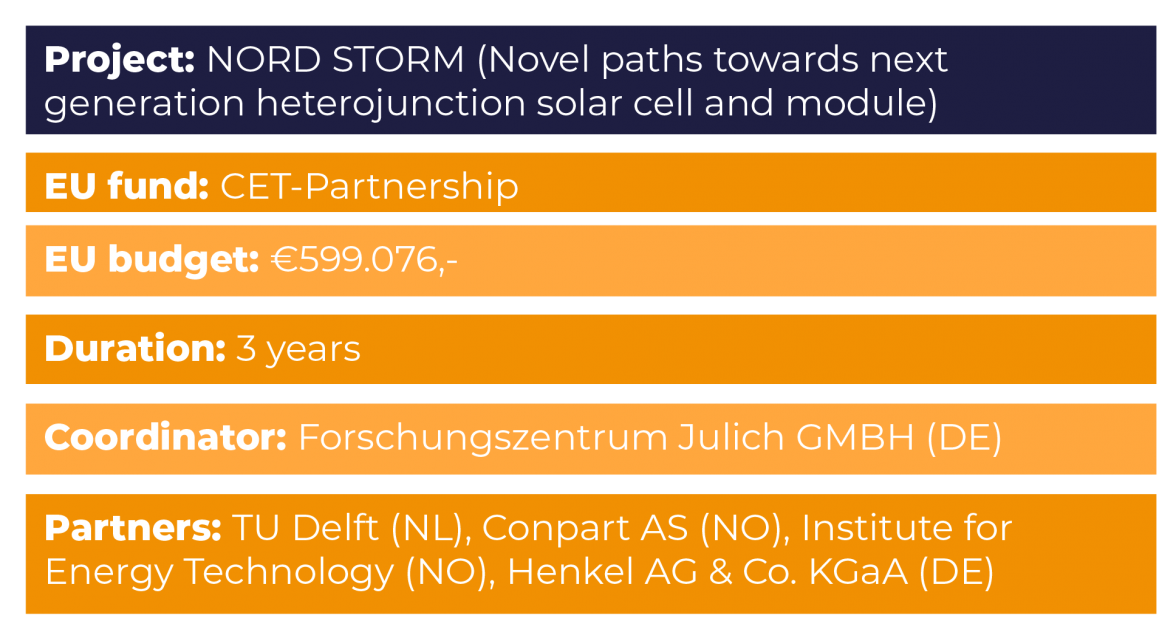
Today, high-efficiency silicon heterojunction (SHJ) solar cells still rely on two expensive and relatively scarce materials: indium (used in a coating that conducts electricity while staying see-through) and silver (used in the wiring that carries the electrical current). This means production costs are high and there are significant supply-chain and material-availability risks. Dr. Zhao and Dr. Beijer explained that the international team led by Forschungszentrum Jülich in Germany and including the Photovoltaic Materials and Devices (PVMD) group of TU Delft, set out to produce a more efficient and cost-effective kind of solar cell.
More specifically, the NORD STORM project focuses on improving SHJ solar cells in several ways. The team is working on replacing the indium and silver components with cheaper and more readily available components. At the same time, the project aims to improve the efficiency of the SHJ cells by adding, among other components, ultra-thin layers of special materials (transition metal oxides) to the cells. The ultimate objective is a conversion efficiency (meaning how much of the sun’s energy gets transformed into useable electricity) of over 25% for this new generation of solar cells.
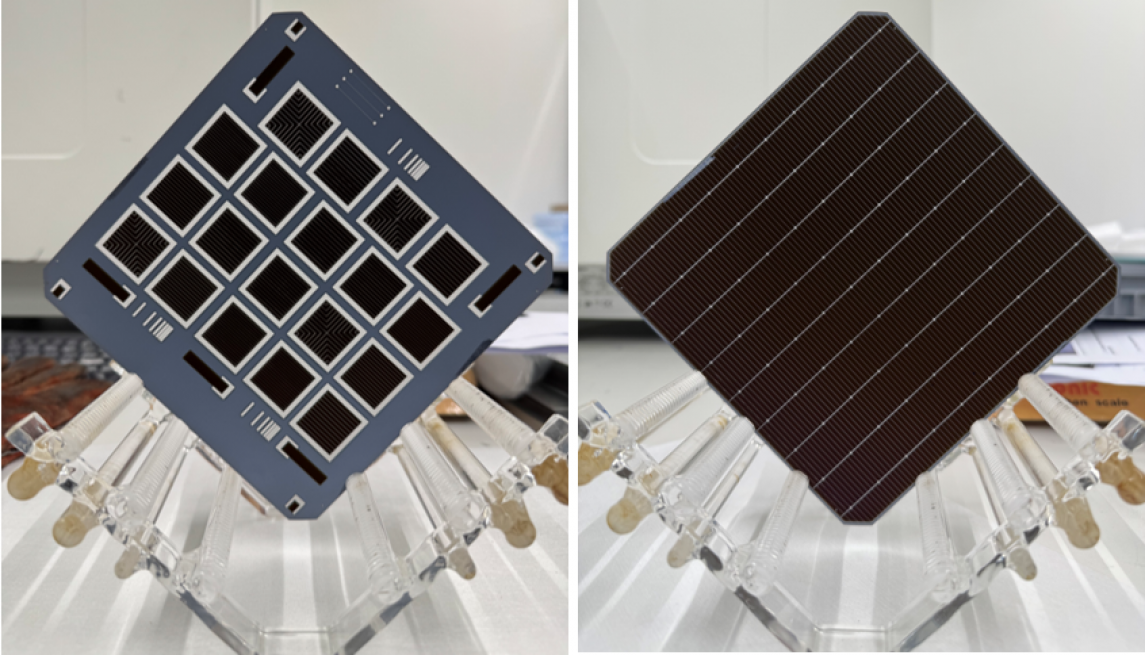
Photos of M2+-sized c-Si wafers with solar cells featuring MoOx-based hole-transport layer (HTL).
The project is financed under the co-funded CETPartnership, which started in 2022 and will launch calls until 2027. The overall aim of this partnership is to “empower the clean energy transition and contribute to the EU’s goal of becoming the first climate-neutral continent by 2050”. To do this, it focuses on facilitating transnational innovation ecosystems, thereby reducing fragmentation across the Union. Concretely, it brings together partners from 30 different countries who work together by pooling research and innovation (R&I) budgets and setting out joint priorities in annual calls.
NORD STORM was granted funding under the first CETPartnership Joint Call (TRI2 call module 2.2: “Enhanced zero-emission power technologies focused on breakthrough R&D to increase energy efficiency”). It is expected to be finalised by the end of 2026, meaning that its results will provide an early example of the possible positive outcomes of the partnership. However, this is not to say that the project has not already achieved significant milestones: SHJ solar cells developed by the consortium have already achieved a conversion efficiency of more than 24%, while minimising the consumption of silver and indium. In the final six months of the project, the team is looking to produce these next generation solar cells in a way that is compatible with industrial production processes.
With the push towards greater energy independence as a result of the war between Russia and Ukraine and, more recently, between the US and Iran, Dr. Beijer and Dr. Zhao highlighted that the project results align with the EU’s strategic agenda. By developing advanced, cost-efficient solar technologies and reducing dependence on rare materials, the project supports Europe’s technological leadership, industrial competitiveness and energy independence in the global renewable energy market. In this way, it contributes to European policy goals such as the European Green Deal, REPowerEU and climate neutrality by 2050. At the same time, its outcomes are aligned with, among others, the objectives of the Critical Raw Materials Act and the Green Deal Industrial Plan.
Just as the project is looking to create pan-European impact, it is also dependent on pan-European collaboration. Both Dr. Zhao and Dr. Beijer stressed that the complexity of the challenges that NORD STORM seeks to tackle – the quest towards greater energy independence, lower solar cell production costs and less vulnerable supply-chains – are too significant for one member state to tackle alone. The required expertise, infrastructure and additional funding, as well as the knowledge and production chain and scalability on which ultimate market success is dependent, cannot be realised without broad international collaboration. Precisely because NORD STORM is an example of a multidisciplinary consortium combining leading research institutes and industry partners from multiple European countries, it has been able to achieve the objectives set out at the start.
 Dr. Yifeng Zhao is an Assistant Professor in the Photovoltaic Materials and Devices (PVMD) group at TU Delft, where he earned both his MSc and PhD with cum laude distinction. His research focuses on pushing the boundaries of high-efficiency crystalline silicon (c-Si) and multi-junction solar cells. Through advanced device engineering and simulation-assisted design, his work has been instrumental in demonstrating silicon heterojunction solar cells exceeding 24% efficiency and tandem solar cells surpassing 32% efficiency. Currently leading the c-Si research team at TU Delft, Dr. Zhao directs extensive international collaborations and co-mentors a dynamic team of young researchers. His overarching research vision is centered on pioneering 'Photovoltatronics.' By developing high-efficiency single and multi-junction solar cells, his work aims to transform sustainable energy harvesters into intelligent agents capable of simultaneous power generation and data communication.
 Dr. Steven Beijer works as program officer in the Applied & Technical Sciences domain at the Dutch Research Council (NWO). Here, he focuses on the energy transition, with an emphasis on electrochemistry and energy materials. A chemist by training, he earned both his MSc and PhD at the University of Amsterdam – broadly on energy and sustainability, more specifically on the sustainable use of phosphorus. His MSc thesis was awarded the Unilever Research Prize 2019, working on what would become SusPhos B.V. He likes to position himself on the intersection where science, business, policy-making and industry meet and to build bridges between the various disciplines and perspectives required to effectively transition to a cleaner, fairer and more circular society.
How do we prepare young Europeans to work alongside robots and algorithms? Why should we measure radio waves with European partners? And how can medical institutions adopt artificial intelligence in line with GDPR? These are the sorts of questions we explore in our special article series, Knowledge Without Borders. Covering education, research, and innovation, Neth-ER tells stories from across the European knowledge sector showing the impact of European collaboration and EU funding.
Register now: Neth-ER Network Conference 2026
Concurrentiekracht en strategische autonomie opnieuw centraal in State of the Union
Neth-ER publishes recommendations for dual-use R&I in Horizon Europe 2028–2034
Canada en de EU streven naar intensievere samenwerking op Erasmus+ en Horizon Europe